Loading... Today

-- 0

-- 0

The Electrical Post
Global Power Sector :
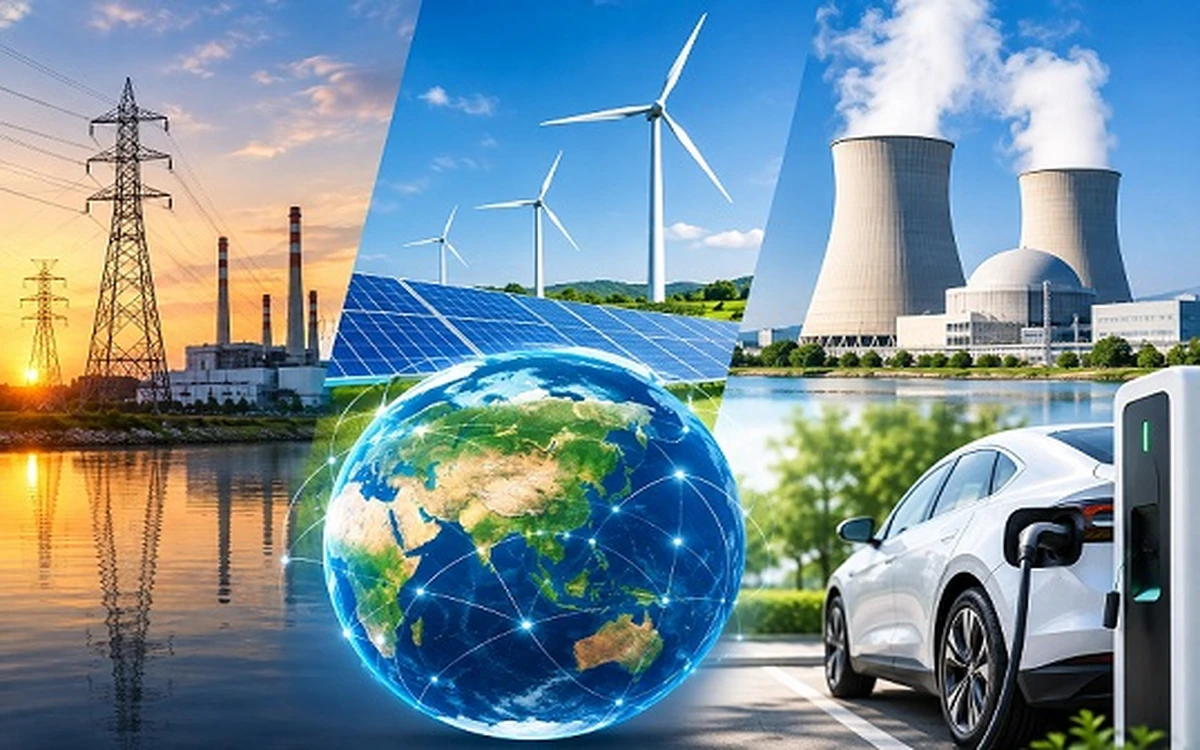
The year 2025 was defined by steady economic growth, record investments in renewable energy and shifting generation trends. Rising electricity demand was fulfilled with unprecedented renewable capacity additions, especially solar and wind. Investment flows reached new highs; nuclear energy held steady, with new projects under construction, while green hydrogen struggled to scale amid cost and infrastructure challenges. Electric vehicle sales surged worldwide, with adoption spreading rapidly across emerging markets. Together, these developments highlighted both the progress and complexities of steering towards a low-carbon future.
Sustained Uptick in Power Demand
In 2025, global economic activity continued to rise steadily, with GDP expanding by 3.4% according to the IMF’s April 2026 World Economic Outlook. The year also ranked among the warmest on record, as reported by the World Meteorological Organization. Electricity demand grew by nearly 3%, exceeding the decade-long average of 2.8%. This growth was driven primarily by industry, household appliances, and commercial buildings (excluding data centres). While demand from electric vehicles (+18%) and data centres (+17%) surged, their overall contribution to demand growth remained relatively small.
Annual global investment in the energy transition technologies reached a record $ 2.3 trillion in 2025, marking an 8% year on-year increase. The three largest sectors by investment were electrified transport ($ 893 billion), renewable energy ($ 690 billion), and grid infrastructure ($ 483 billion) (Source: BNEF). However, renewable energy investment declined by 9.5% compared to the previous year, largely due to uncertainty about changes in power market regulations in China. Investment levels rose across most sectors, apart from hydrogen ($ 7.3 billion) and nuclear ($ 36 billion).
Significant RE Capacity Addition
In 2025, global annual renewable capacity additions (including hydropower) rose by 16%, reaching approximately 800 GW. Solar PV led the expansion, with around 605 GW added worldwide—an increase of about 12% y-o-y—bringing the total installed solar capacity to nearly 2,800 GW. Wind power contributed around 160 GW of new capacity, raising global wind installations to about 1,300 GW. Other renewables, including hydropower, added roughly 35 GW in 2025.
Increased share of RE in generation mix
Global renewable generation rose to 10,808 GWh in 2025, marking an 8.7% y-o-y increase and increasing its share of the generation mix to about 34%. Solar PV contributed an additional 600 TWh, bringing total solar generation to 2,700 GWh, around 8% of the global mix. Wind power generation also grew by approximately 8%. In contrast, coal-based generation declined marginally by 0.4% in 2025, the first such drop since 2019 (excluding the COVID-19-affected year of 2020).
Nuclear power capacity remains unchanged
While 3 GW of new nuclear capacity came online in 2025, almost the same capacity was retired (mainly in Belgium). As a result, total global nuclear capacity remained constant at 420 GW by 2025-end, with reactors in operation in over 30 countries. However, nuclear generation recorded an uptick of 1.2% y-o-y in 2025. Nuclear reactors with a combined capacity of 78 GW are currently under construction in 15 countries (half of the under-construction capacity is in China). Due to its low-emissions, round-the-clock power supply ability, tech firms are increasingly turning to nuclear energy to power the increasing demand of data centres.
Robust growth in EV sales
EV passenger vehicle sales were estimated at 22 million (up 25% y-o-y) in 2025. China accounted for nearly two-thirds of the figure, followed by Europe with 17% and the US with 7%. EV sales in emerging markets are now growing quickly as Chinese automakers ramp up sales outside of their home country. Suggesting a wider penetration of EVs in developing countries, Thailand now has higher EV adoption rates than the US, while Brazil is ahead of Japan.
Battery storage accelerates globally
Battery storage deployment grew at an exponential pace, with 108 GW of new battery storage capacity deployed globally, up 40% from 2024. Lithium iron phosphate (LFP) batteries now account for around 90% of deployments. The growth was supported primarily by utility scale storage, which contributed almost 80% of new battery capacity, while the remainder came from behind-the-meter capacity. Battery based uninterruptible power supplies (UPS), primarily in data centres, also witnessed significant growth, with capacity additions rising by 30% to 45 GW in 2025.
The Above report has been extracted from Tata Power’s annual report for FY 25-26
1 days ago
Total Views : 5
2 days ago
Total Views : 4
last week
Total Views : 15

last week
Total Views : 31

last week
Total Views : 18
2 weeks ago
Total Views : 32
2 weeks ago
Total Views : 33
3 weeks ago
Total Views : 66
3 weeks ago
Total Views : 136
3 weeks ago
Total Views : 86