Loading... Today

-- 0

-- 0

The Electrical Post
Global Industrial Gearbox Market
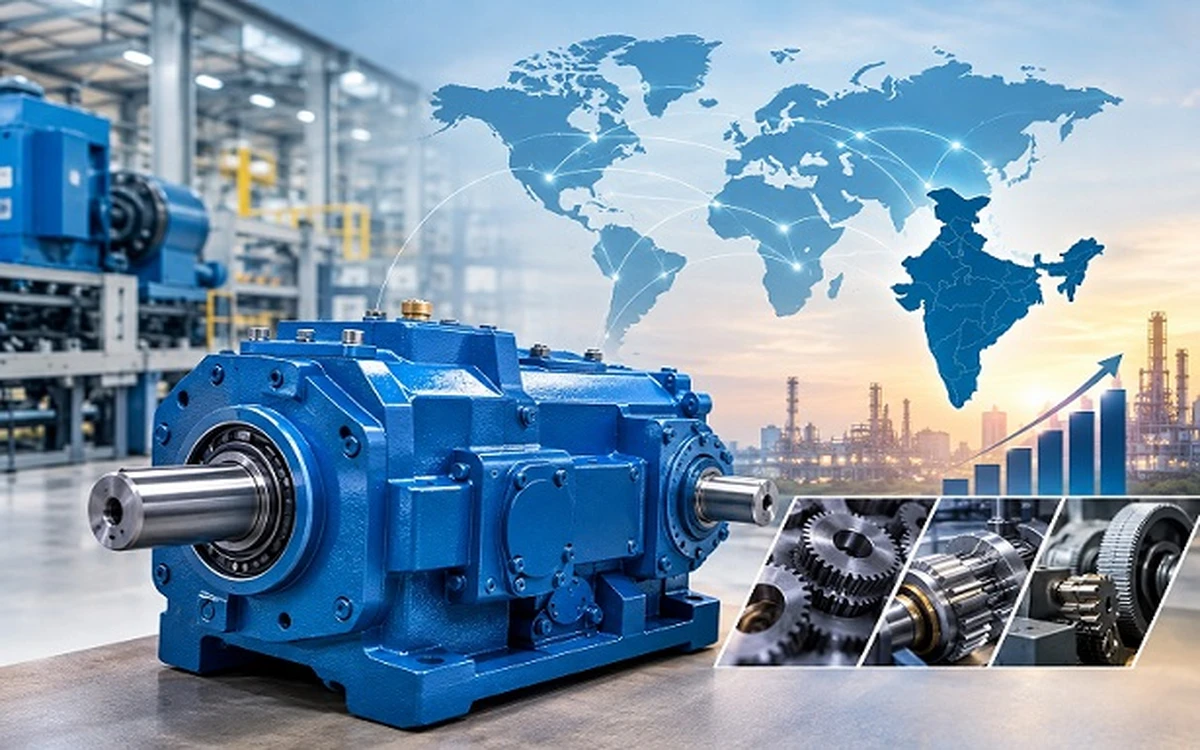
The global industrial gearbox market is expected to grow at a CAGR of 4.8% from 2026 to 2033. The demand continued to be supported by demand from core industrial sectors such as power, metals, cement, mining, and material handling, alongside the broader shift towards automation, process efficiency, and renewable energy applications. Demand continues to be shaped by the need for reliable torque transmission, energy-efficient drive systems, and replacement demand across installed industrial bases.
The market environment also remains influenced by industrial investment cycles and end-use sector capacity additions. As industries continue to modernise operations, gearbox demand is increasingly linked not only to greenfield capex, but also to brownfield upgrades, automation-led retrofits, and higherefficiency drivetrain requirements. This supports a structurally stable demand outlook for industrial gear systems across heavy-duty applications.
Indian Industrial Gearbox Market
According to IMARC Group, India’s industrial gearbox market is projected to grow at a 3.9% CAGR through 2034 with the support of industrialisation, infrastructure build-out, and investment across manufacturing sectors.
Going forward, easing geopolitical tensions, normalised trade and tariff conflicts, and improving supply chain stability are expected to strengthen business confidence and support industrial investments. Improved raw material availability and moderation in commodity price volatility are also likely to aid operational efficiency and project execution timelines going forward.
Along with sustained investments in key segments, mining and material handling are expected to remain key growth drivers supported by rising domestic coal production and investments in bulk material handling infrastructure. At the same time, increasing focus on productivity, reliability, and lower lifecycle costs is accelerating demand for technologically advanced and customised power transmission solutions.
Overall, the outlook for the industrial gearbox segment in FY 2026-27 looks cautiously optimistic, driven by expanding manufacturing activity, rising demand for energy-efficient systems, and continued investment across key sectors.
Indian Material Handling Equipment Industry
The Indian bulk material handling equipment industry is expected to remain on a steady growth trajectory, entering the new financial year, backed by increasing investments in mining, power generation, and ports.
During FY 2025-26, although government-led spending continued, the slower conversion of announcements into on-ground execution impacted project timelines and ordering activity within the industry.
Looking ahead, improved project execution, revival in private sector expenditure, and stronger industrial activity are expected to support demand for efficient bulk material handling systems. Growth in coal handling infrastructure is also expected to accelerate, aligned with Coal India Limited’s long-term production targets for 2030 and the continued focus on strengthening import substitution of coal.
For both business segments, we remain cautiously optimistic, aided by easing geopolitical tensions and backed by a healthy order book across segments, providing confidence in a positive outlook.
Key Industry Drivers
Infrastructure expansion remained a core demand driver for industrial equipment in 2025-26. The Economic Survey highlighted that the Government of India’s capital expenditure increased nearly 4.2 times from Rs. 2.63 Lakh Crore in 2017- 18 to Rs. 11.21 Lakh Crore in 2025-26 (BE), while effective capital expenditure for 2025-26 (BE) stood at Rs. 15.48 Lakh Crore. Progress across roads, railways, airports, and logistics continued to support activity in construction, bulk material movement, and industrial project execution, creating a favourable demand environment for transmission and material handling equipment.
The power sector remained one of the most important industry drivers during the year. India’s total installed power generation capacity increased to 532.74 GW as on March 31, 2026, supported by continued capacity additions across conventional and renewable sources. The country also successfully met peak power demand of 242.49 GW during FY 2025- 26, while national energy shortages remained negligible at 0.03%, reflecting sustained investments in generation and transmission infrastructure.
Thermal capacity additions also remained active during the year. As of January 20, 2026, around 17.36 GW of thermal capacity had been commissioned since April 2023, while 39.55 GW was under construction and contracts for another 22.92 GW had been awarded and were due for construction. These trends indicate a continuing investment cycle across generation, evacuation, and balancing infrastructure, supporting demand for heavy-duty gear systems and bulk material handling equipment.
Cement demand remained firm, supported by infrastructure creation, housing, and construction-linked activity. The Economic Survey noted steady growth in cement production as part of the broader improvement in construction indicators, with the Index of Eight Core Industries projecting cement output increasing by 9.4% in April 2026 and 8.7% cumulatively during April to March 2025-26 over the corresponding period of the same year. This reflected sustained activity in end-use sectors that typically require material-handling, crushing, conveying, and power-transmission solutions.
Steel production also remained a significant driver of the industry during the year. According to the Ministry of Steel, India’s steel sector continued to maintain growth momentum in April 2026. Crude steel production stood at 14.09 million tonnes, up 5.8% year-on-year, while finished steel production reached 13.05 million tonnes, registering 3.4% year-on-year growth. Finished steel consumption stood at 12.99 million tonnes, up 8.1% year-on-year, reflecting sustained demand from infrastructure, construction, and manufacturing end-use segments. These trends indicate continued momentum in steel production and consumption, supported by infrastructure activity and industrial demand, and remain favourable for equipment demand across mills, process lines, and associated material handling systems.
The above report has been extracted from Elecon Engineering’s annual report for Fy 25-26

1 days ago
Total Views : 6

1 days ago
Total Views : 12
1 days ago
Total Views : 6
last week
Total Views : 18
last week
Total Views : 22
2 weeks ago
Total Views : 52

2 weeks ago
Total Views : 104
2 weeks ago
Total Views : 68

2 weeks ago
Total Views : 104
2 weeks ago
Total Views : 62