Loading... Today

-- 0

-- 0

The Electrical Post
Overview of the FMEG Market
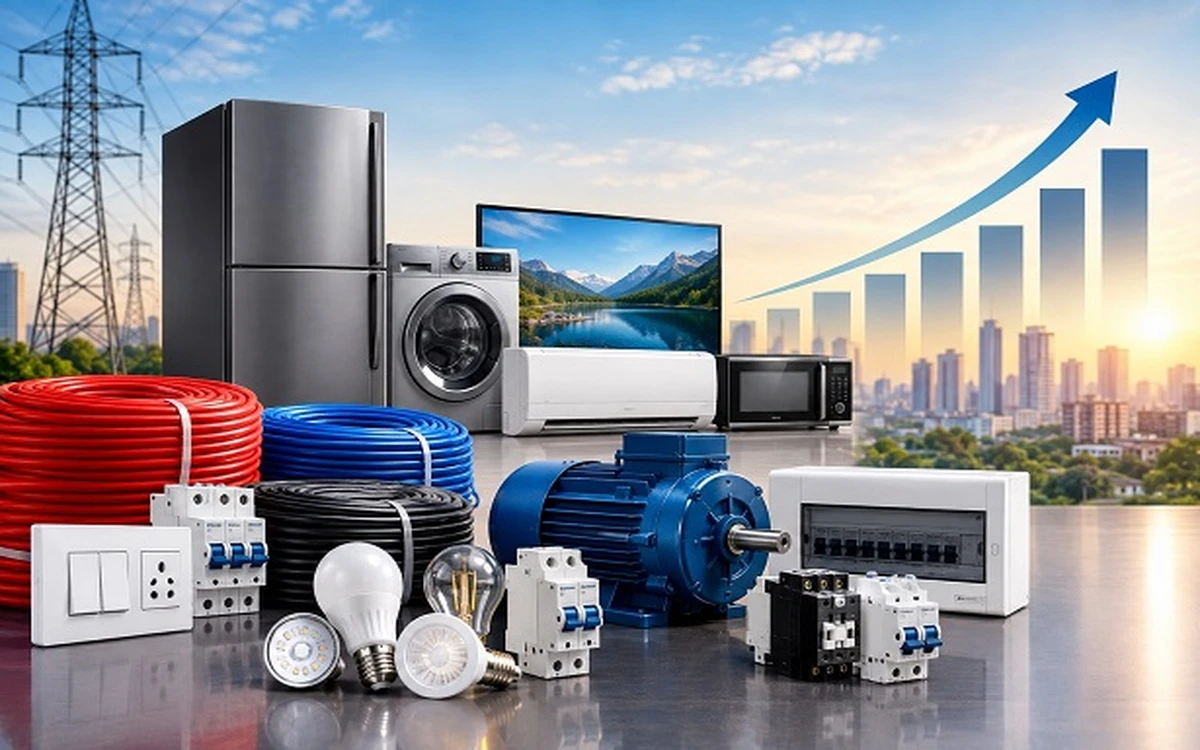
The Fast-Moving Electrical Goods (FMEG) sector in India has undergone a fundamental shift. What was once a seasonal, price-driven market is now a lifestyle and technology-led category. Consumers increasingly choose products based on energy efficiency, design, and smart connectivity, alongside price. The market is expected to surpass INR 1,46,500 Crores in the near term. This growth is driven by rising household incomes, stricter energy efficiency mandates, and rapid adoption of smart home ecosystems across urban and semiurban India. The organised segment is the primary beneficiary of this transformation. As consumers shift away from unbranded local products to certified, energy-rated offerings from established players, branded manufacturers are gaining both volume and margin. This formalisation trend, already well established in wires and cables, is equally evident in FMEG. As a result, it is reshaping distribution, product development, and competitive positioning across sub-categories.
Key Sub-Categories
Fans
Fans remain the highest-volume sub-category in the FMEG segment, with shipments projected at 9.5 Crore units in FY 2025-26. The key technology shift is the rapid adoption of BLDC (Brushless DC) motors, which consume up to 65% less electricity than conventional induction fans. What began as a premium offering has quickly become the category standard, driven by Bureau of Energy Efficiency (BEE) star-rating mandates and rising electricity costs that make savings more tangible for households.
At the same time, smart fans are gaining traction. These fans offer app or voice control, along with variable speed and scheduling. Adoption is strongest in metro cities. Meanwhile, the replacement cycle for the estimated 38 Million fans sold annually is increasingly shifting towards BLDC models. This trend is creating sustained upgrade demand and favouring technology-led brands.
Lighting
India’s lighting market has largely completed its LED transition and is now moving towards connected and professional-grade solutions. At the consumer level, basic LED lamps have become commoditised. As a result, growth is shifting to connected lighting systems that integrate with smart home platforms, enabling remote control of brightness, colour temperature, and schedules.
On the commercial side, demand remains strong. Premium offices, airports, stadiums, and large-format retail developments are driving growth in architectural and professional lighting. This segment offers higher value and better margins, despite longer sales cycles. Additionally, government programmes such as UJALA and SLNP continue to generate bulk demand, although competition remains intense.
Switches, Switchgear and Wiring Accessories
This sub-category has witnessed significant premiumisation in recent years. Modular switches with designer finishes, such as brushed metal, glass, and minimalist white, are now standard in mid-range and premium homes. As a result, purchase decisions are shifting from electricians to consumers.
At the same time, smart switchgear is emerging as the next layer of innovation. MCBs and distribution boards now feature energy monitoring, remote trip capability, and integration with building management systems. These features allow users to track real-time electricity consumption, which is increasingly valuable as tariffs rise. In parallel, commercial and industrial switchgear demand remains strong, supported by data centre expansion and manufacturing growth under PLI schemes.
Appliances (Heaters, Geysers, Air Coolers and Small Domestic Appliances)
Rising temperatures and longer summers have reshaped demand across this sub-category. Products once seen as seasonal, such as air coolers, geysers, and heaters, are now essential and used year-round.
Air coolers are seeing strong growth, particularly in Tier-II and Tier-III cities and rural markets, where they serve as an affordable alternative to air conditioning. At the premium end, connectivity trends are also emerging. Wi-Fi-enabled geysers, smart air coolers with humidity control, and app-connected heaters are now available, catering to specific consumer demands.
Key Growth Drivers
Bureau of Energy Efficiency (BEE) Mandates
BEE’s star-rating framework remains the most powerful structural driver in the FMEG market. Mandatory minimum energy performance standards (MEPS) are steadily raising efficiency benchmarks across products such as fans, air conditioners, and refrigerators. This shift is phasing out non-compliant products and accelerating replacement demand.
For manufacturers with strong R&D and certified portfolios, this creates a clear advantage. However, for those reliant on low-efficiency products, it presents significant pressure. The mandate-driven upgrade cycle is expected to continue through the decade, as BEE tightens standards across categories.
Rural Electrification and Rising Incomes
Rural India has emerged as a key growth frontier for FMEG. Improved grid reliability under schemes such as SAUBHAGYA, along with rising incomes and aspirational consumption, has expanded demand across categories. As a result, rural households are now purchasing fans, lighting, and small appliances at scale.
Rural demand accounts for approximately 36% of total FMEG spending and continues to grow. Importantly, consumers are not defaulting to the lowest-priced products. Instead, they are becoming more brand-aware and quality-conscious, creating opportunities for organised players with strong distribution and brand recognition.
The above report has been extracted from the annual report of RR Kabel for FY 25-26

1 days ago
Total Views : 26
1 days ago
Total Views : 20
1 days ago
Total Views : 12
1 days ago
Total Views : 89
1 days ago
Total Views : 24
last week
Total Views : 62
last week
Total Views : 16
last week
Total Views : 54
last week
Total Views : 18
.webp)
last week
Total Views : 23