Loading... Today

-- 0

-- 0

-Underscoring the need to integrate cooling efficiency and efficient resource planning
The Electrical Post
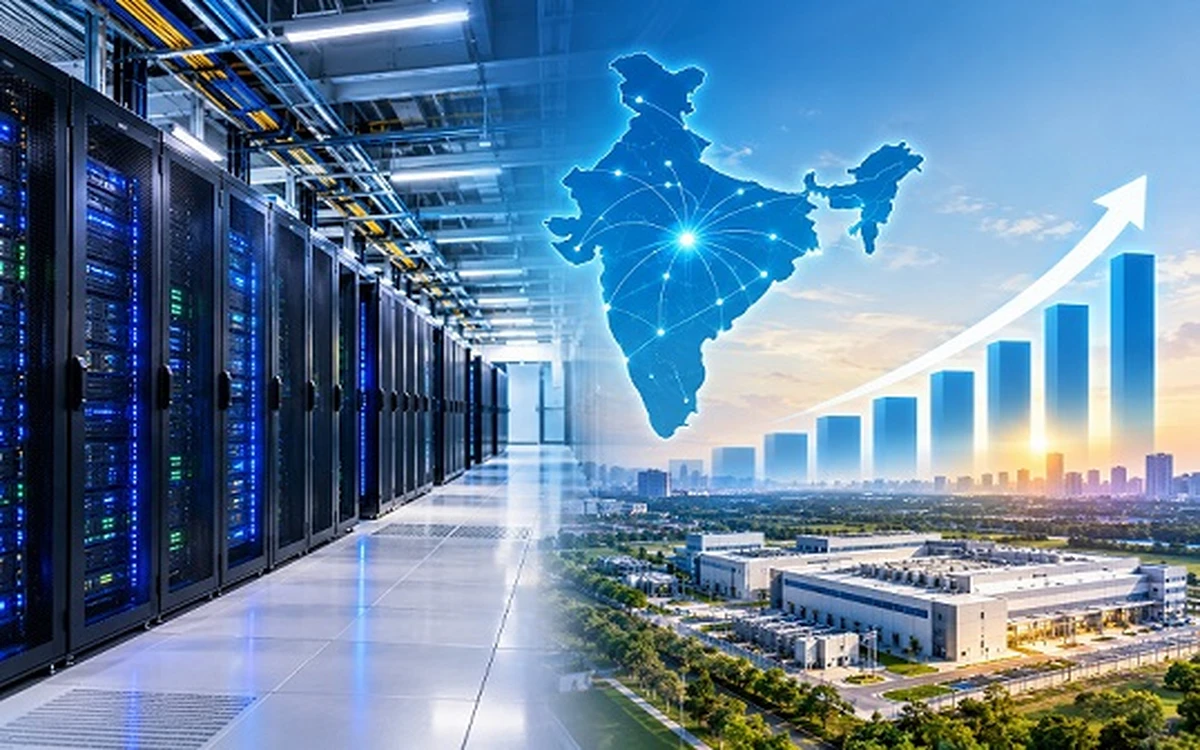
Data centres (DCs) are foundational components of modern digital infrastructure, enabling cloud computing, artificial intelligence, telecommunications, and the delivery of digital services. As India’s digital economy expands, DC capacity is growing rapidly in scale and complexity. Rapid digitalisation, expanding cloud and hyperscale deployments, AI-driven workloads, 5G rollout, and data localisation requirements are driving sustained growth, positioning India among the fastest-growing DC markets globally. The Union Budget 2026–27 reinforces India’s ambition to emerge as a global hub for AI and cloud infrastructure, recognising DCs, particularly AI DCs, as critical digital infrastructure. With investments exceeding USD 70 billion already underway and a further USD 90 billion announced, the budget introduces a tax holiday till 2047 for foreign cloud service providers operating from India, along with safe harbour provisions for related-party DC services. This long-term policy signal positions India among the leading global destinations for hyperscale and AI-driven DC development.
This rapid growth, while economically strategic, also introduces significant environmental challenges. DCs impose three closely interlinked environmental pressures, such as energy consumption, water use, and associated greenhouse gas (GHG) emissions, with cooling systems acting as the central nexus. Power Usage Effectiveness (PUE) captures the ratio of total facility energy consumption to IT energy consumption, and it reflects how efficiently electricity is used in productive computing rather than consumed by overhead systems such as cooling and other energy end uses. In parallel, Water Usage Effectiveness (WUE) has emerged as a critical sustainability metric, as cooling choices can drive high water consumption. This concern is particularly acute in water-stressed regions of India.
Industry projections suggest that India’s DC installed power capacity, currently at 1.6 GW, is expected to exceed 2 GW by 2026, with total capacity projected to grow nearly fivefold to more than 8 GW by 2030, which would translate into a total DC-connected electrical load of about 12 GW. This is equivalent to the electricity demand of 10–12 million Indian households and exceeds Delhi’s current peak power demand of about 9 GW. At this scale, DCs will operate as infrastructure comparable to India’s largest metropolitan electricity loads, underscoring the need to integrate cooling efficiency and efficient resource planning into power and urban infrastructure governance.
Cooling accounts for approximately 30–40% of total DC electricity consumption, with an even higher share in older or sub-optimally designed facilities. Cooling systems play a decisive role in shaping the environmental footprint of DCs, particularly in warm and humid climates such as India’s, where thermal management requirements are inherently higher. Cooling technologies, especially evaporative and water-cooled systems, are also the primary source of direct water consumption in DC operations. While much of India’s existing DC stock operates at moderate rack power densities of 4–8 kW per rack, new hyperscale and AI-ready facilities are being designed for substantially higher densities. Leading AI platforms already support rack power densities exceeding 120 kW, conventional air-based cooling systems are approaching their technical limits and can no longer provide reliable heat removal without significant energy penalties. At these densities, liquid cooling technologies, particularly direct-to-chip cooling, rear-door heat exchangers, and immersion cooling, become a functional requirement rather than an optional efficiency upgrade, due to their significantly higher heat transfer capacity and ability to maintain thermal stability at lower energy use. The gradual penetration of high-density and mixed-load configurations will materially increase both cooling energy demand and water requirements.
Publicly disclosed information indicates that the PUE values across Indian DCs vary significantly, ranging from around 1.3–1.4 in newer hyperscale facilities to 1.8 or higher in older and colocationfocused centres, reflecting wide differences in cooling efficiency, design, and operational maturity. Hyperscale operators generally report lower PUEs due to advanced cooling architectures and tighter operational optimisation, while legacy and mixed-use facilities exhibit higher energy overheads. With an average PUE of around 1.52, total electricity consumption would be about 90 TWh annually. Given India’s grid emission factor of about 0.71 kg CO2e/kWh, this corresponds to around 64 million tonnes of CO2e per year from DC operations alone.
Water use also varies widely, driven by cooling technology and climatic conditions, with WUE typically ranging from about 1.5 to 3.0 litres per kWh in water-cooled and evaporative systems, particularly higher in warm regions. A mid-sized DC of around 15 MW capacity can consume about 105 million gallons of water annually for cooling, comparable to the yearly water use by 20000 rural households. Scaled to India’s projected 8 GW of IT capacity, cooling-related water demand could reach approximately 36–59 billion gallons per year, depending on cooling configuration and climate conditions.
At present, thermal energy storage (TES) in data centres is mainly used to meet Tier reliability requirements by providing short-duration backup cooling, typically 5–15 minutes, during power interruptions and transition to backup systems. However, its role can be expanded beyond resilience to support sustainability and grid flexibility. TES can enable load shifting by storing cooling capacity during off-peak hours or periods of high renewable energy availability and using it during peak demand periods, thereby reducing chiller operation during grid stress, lowering peak electricity demand, and improving PUE. In parallel, dedicated renewable power procurement through open access, captive solar and wind, group captive models, and long-term power purchase agreements (PPAs) can reduce grid carbon intensity and improve Carbon Usage Effectiveness (CUE). Integration of TES with battery storage, demand-response mechanisms, grid-aware load management, and waste heat recovery can further enhance operational reliability, renewable energy utilisation, and Energy Reuse Effectiveness (ERE).
Together, PUE and WUE highlight how cooling strategy choices, air-based, hybrid, or water-intensive, critically shape the energy, water, and carbon footprint of DCs, particularly in water-stressed regions and fossil-fuel-dependent power systems such as India’s. However, PUE and WUE data in the public domain remain sparse, fragmented, and largely self-reported, limiting comparability and independent verification. This lack of consistent, standardised disclosure constrains sector-wide benchmarking and underscores the need for structured performance reporting to enable evidence-based policy and more sustainable DC growth.
India’s climatic diversity, high ambient temperatures, seasonal humidity, and increasing frequency of heat waves further amplify the importance of cooling performance. Many major DC clusters are located in urban and peri-urban regions already experiencing power system congestion, peak demand stress, and growing water scarcity. In India, data centres are concentrated in Mumbai, Chennai, NCR, Bengaluru, Hyderabad, and Pune, but these hubs are also facing significant challenges. Mumbai and Chennai, the largest hyperscale hubs, face high temperatures, humidity, and growing freshwater scarcity, with Chennai’s 2019 water crisis clearly exposing the risks of water-intensive cooling systems. NCR faces extreme summer heat, very high peak electricity demand, groundwater depletion, and severe cooling stress during prolonged heatwaves. Bengaluru and Hyderabad are witnessing rising pressure on urban water supply and grid reliability as large-scale data centre capacity expands. Pune offers relatively better climatic conditions, but it is also seeing increasing demand for power and water.
Cooling decisions made at the design and policy level therefore have long-term implications not only for facility-level efficiency, but also for grid resilience, urban water systems, and local environmental outcomes. From a policy perspective, cooling systems differ fundamentally from IT equipment. While server efficiency and IT hardware performance are largely driven by global technology cycles and vendor innovation, cooling system design, configuration, and operation are strongly shaped by local climatic conditions, water availability, electricity tariffs, land constraints, and regulatory signals. Cooling infrastructure is also long-lived, with typical asset lifetimes of 15–25 years, meaning inefficient design choices can lock in high energy and water intensity for decades.
Importantly, significant efficiency gains are achievable through cooling-side interventions without constraining digital innovation or computing growth. Measures such as improved airflow management, temperature and humidity optimisation, climate-appropriate cooling strategies, operational monitoring, and responsible refrigerant use can deliver substantial reductions in both energy and water use, often at relatively low cost and with strong retrofit potential. From a governance standpoint, cooling efficiency therefore represents a low-regret entry point for policy action. Unlike IT hardware choices, which policymakers have limited leverage over, cooling performance can be effectively influenced through disclosure, guidance, incentive alignment, and integration with power and water planning, directly improving PUE and WUE outcomes while preserving technology neutrality for operators.
The above report has been extracted from the Alliance for an Energy Efficient Economy (AEEE)’s latest report on India’s Data Center
1 days ago
Total Views : 26

1 days ago
Total Views : 21
1 days ago
Total Views : 12
1 days ago
Total Views : 89
1 days ago
Total Views : 24
last week
Total Views : 62
last week
Total Views : 16
last week
Total Views : 55
last week
Total Views : 18
.webp)
last week
Total Views : 23