Loading... Today

-- 0

-- 0

The Electrical Post
Overview of the Wires Market
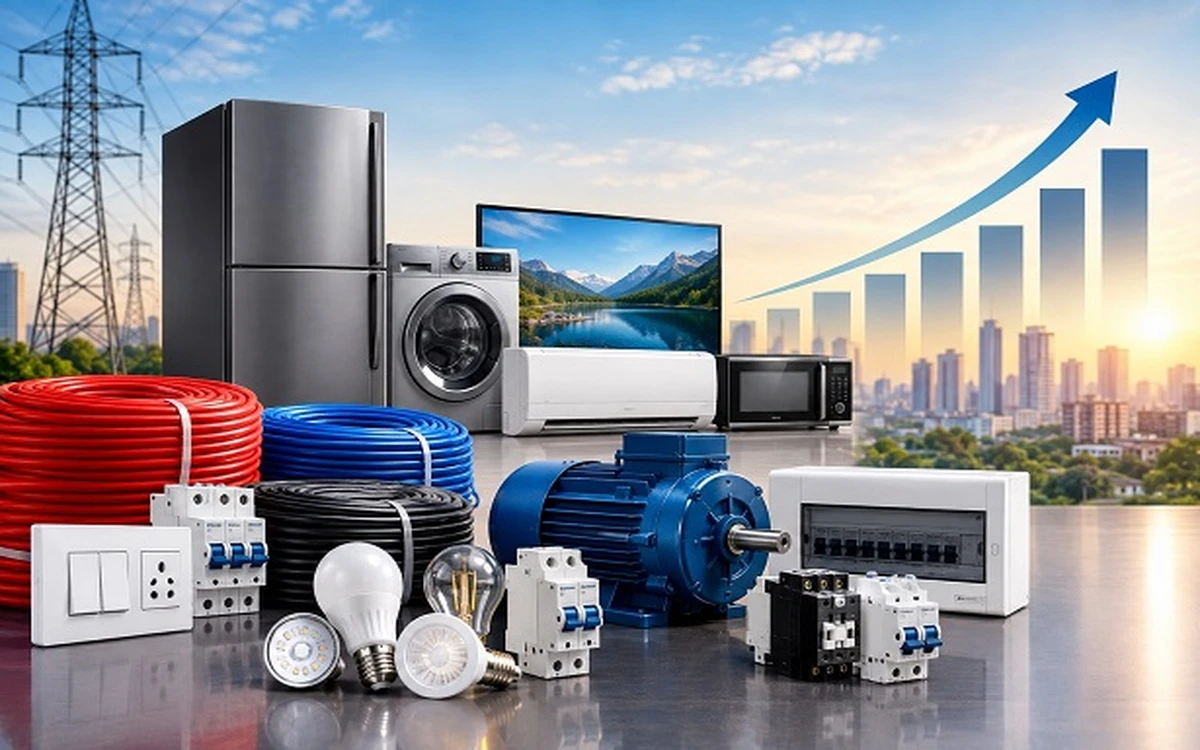
The Indian domestic wire market has undergone a fundamental rerating from a utility commodity into a safety-critical infrastructure input. The Indian wires and cables industry was valued at approximately INR 985 Billion in FY 2024-25 and is estimated to reach INR 1.84 Trillion by FY 2029-30, growing at a CAGR of 13%-14%. The industry is also expected to see increasing formalisation, with the organised segment’s share projected to rise from 76% at present to 82% by FY 2029-30. Within this environment, the wires segment, anchored by housing wires, commands outsized strategic importance. It is the category where distributor cash flows are built, brand equity is established, and the consumers’ daily encounter with electrical safety is decided.
Two structural forces are reshaping the market simultaneously. First, there is a clear shift in purchasing behaviour, a ‘flight to quality’ is steadily reducing the unorganised sector’s share. Mandatory BIS certification is pushing buyers towards organised suppliers. At the same time, state electricity board compliance audits are limiting shelf space for non-IS-marked products at trade counters. Second, the residential boom is driving sustained, volume-led demand. Approximately 6 Lakh new urban homes were completed in FY 2025-26. Developers continue to report strong booking momentum across Tier-I and Tier-II cities.
Key Sub-Categories
Housing Wires:
The housing wires segment, the largest sub-segment, held a ~32% share of the wire and cable market in FY 2024-25. It generated approximately INR 320 Billion in revenue and remained the primary anchor of distributor cash flows. Demand is structurally tied to residential completions, which correlate directly with wiring installation activity.
Critically, the premium mix is deepening and rising per-capita income is driving adoption of FR-LSH (Flame Retardant Low Smoke Halogen-free) and energy-efficient variants, while builders at the premium end are specifying 180-metre rolls to reduce jointing losses, lifting value per unit. Smart home penetration is an additional demand accelerant. Modern automated residences now require nearly 30% more wiring content than conventional homes, driven by decentralised power points, home automation systems, and integrated EV charging provisions. Public-sector housing agencies are also inserting sustainability clauses that favour halogen-free compounds, nudging the supply chain up the technology curve.
Flexible Wires
This sub-segment serves consumer durables, industrial machinery, and automotive sectors, all seeing strong volume growth. This is driven by rising domestic consumption and expanding manufacturing capacity. Flexible wires are also gaining preference in data centres and commercial office fit-outs. Here, cable management and fire safety standards require high-performance, low-smoke products over commodity alternatives.
Overview of the Cables Market
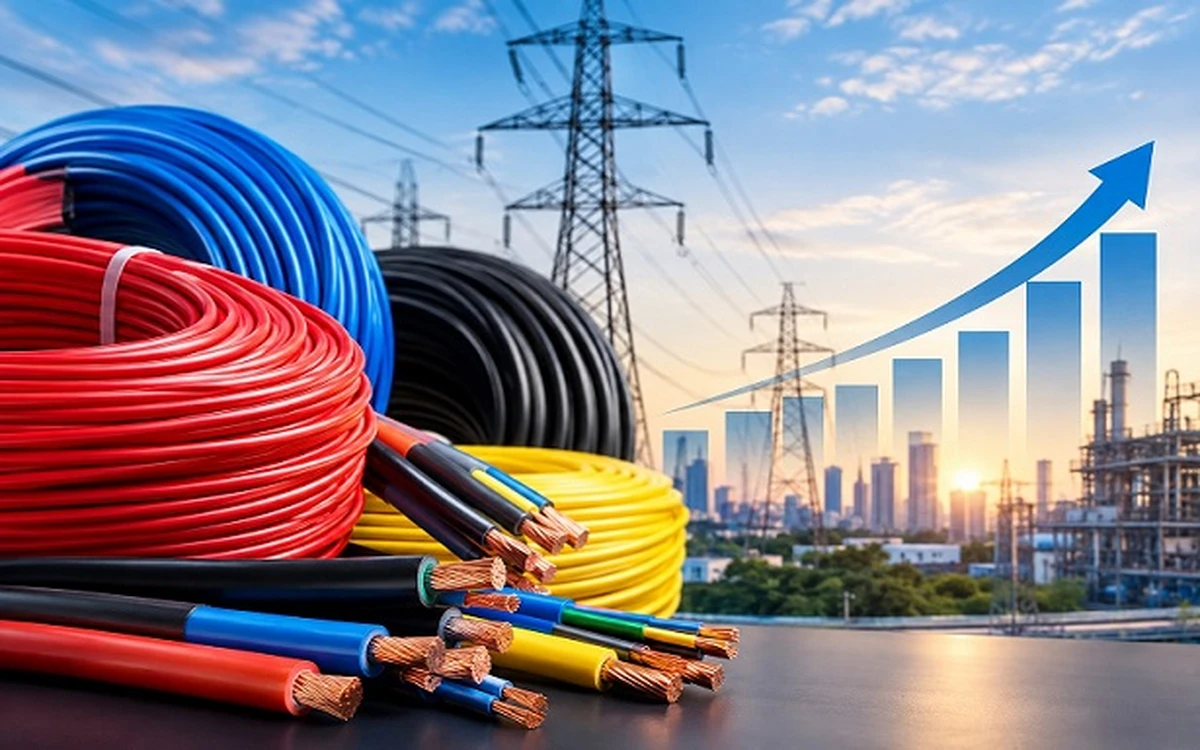
The Indian cable industry has moved well beyond its traditional role in power distribution. Today, it underpins three of India's most critical national programmes, energy transition, digital infrastructure, and urban grid modernisation. The Indian wires and cables industry was valued at approximately INR 985 Billion in FY 2024-25 and is estimated to reach INR 1.84 Trillion by FY 2029-30, growing at a CAGR of 13%-14%. The industry is also expected to see increasing formalisation, with the organised segment’s share projected to rise from 76% at present to 82% by FY 2029-30. Within this, the cables segment is seeing the sharpest growth, driven by rising demand for high-voltage transmission cables, optical fibre, and specialty cables for renewable energy and data infrastructure.
Power Cables (LV/MV/HV)
Low-voltage power cables remain the largest segment, with consumer applications contributing ~69% of FY 2024-25 revenue. However, growth is accelerating at higher voltage levels, reflecting evolving infrastructure needs. The medium-voltage underground distribution cable market is projected to grow faster, as cities replace overhead lines with underground networks to improve reliability and safety.
At the top of the voltage curve, HVDC cables are gaining traction as India builds long-distance transmission corridors to carry renewable power from generation-rich states like Rajasthan and Gujarat to consumption centres in the north and west. Installed renewable capacity reached 217.62 GW by January 2025, and the grid needs thousands of circuit-kilometres of DC cables to make that capacity usable.
Communication, Fibre Optic and Data Cables
Fibre-optic cables are the fastest-growing sub-segment and are projected to expand at around 12%-13% CAGR through 2031. Two demand streams drive this growth.
On the telecom side, only 44% of India’s 7,95,000 mobile towers are currently fibreised, well below the 85-90% levels in China, the US, and South Korea. Increasing fibre connectivity remains essential for 5G to deliver its promised speed and reliability. Telecom operators are targeting near-100% fibre backhaul and 1 Gbps connectivity for 120 Million households. This will sustain long-term demand for armoured and ribbon cables. On the data infrastructure side, domestic fibre output exceeded 100 Million fibre-kilometres in FY 2023-24.
In parallel, data centre operators are expected to invest approximately USD 2 Billion in fibre over this decade. Additionally, NHAI’s planned optical fibre network along 1,46,000 km of national highways, estimated at over INR 35,000 Crores, will further strengthen the fibre deployment cycle.
Solar, Wind and EV Specialty Cables
A single 1 MW solar project requires approximately 50 km of solar cable. Scaled up to India’s 500 GW renewable target, the implied cabling requirement runs into millions of kilometres. Solar-grade cables are UV-stabilised, weather-rated, and built for 1,500 V DC operation. Meanwhile, the PM Surya Ghar rooftop solar scheme has crossed 1 Million installations, strengthening distributed demand. In parallel, offshore wind development off the coasts of Gujarat and Tamil Nadu will introduce demand for submarine and marine cables. Additionally, EV charging infrastructure is emerging as a steady demand source, requiring dedicated medium-voltage feeders for depots and fast-charging networks.
Specialty and Industrial Cables
India’s specialty wire and cable market is projected to grow from USD 0.98 Billion in FY 2024-25 to USD 2.14 Billion by FY 2032-33, at a CAGR of ~10%. This makes it the fastest-growing sub-segment in the wire industry. Growth is driven by accelerating industrialisation across high-complexity sectors. Manufacturing automation, led by Industry 4.0, robotics, and process automation, is a key contributor. The rapid expansion of data centres and pharmaceutical manufacturing zones also drives demand for chemical-resistant, high-temperature cabling. On the energy side, India added a record 24.5 GW of solar capacity in 2024. This directly increases demand for solar-grade cables and medium- and high-voltage grid-tie products
The above report has been extracted from the annual report of RR Kabel for FY 25-26
1 days ago
Total Views : 5

1 days ago
Total Views : 12

1 days ago
Total Views : 6
last week
Total Views : 18
last week
Total Views : 22
2 weeks ago
Total Views : 52
2 weeks ago
Total Views : 103
2 weeks ago
Total Views : 67

2 weeks ago
Total Views : 103
2 weeks ago
Total Views : 62